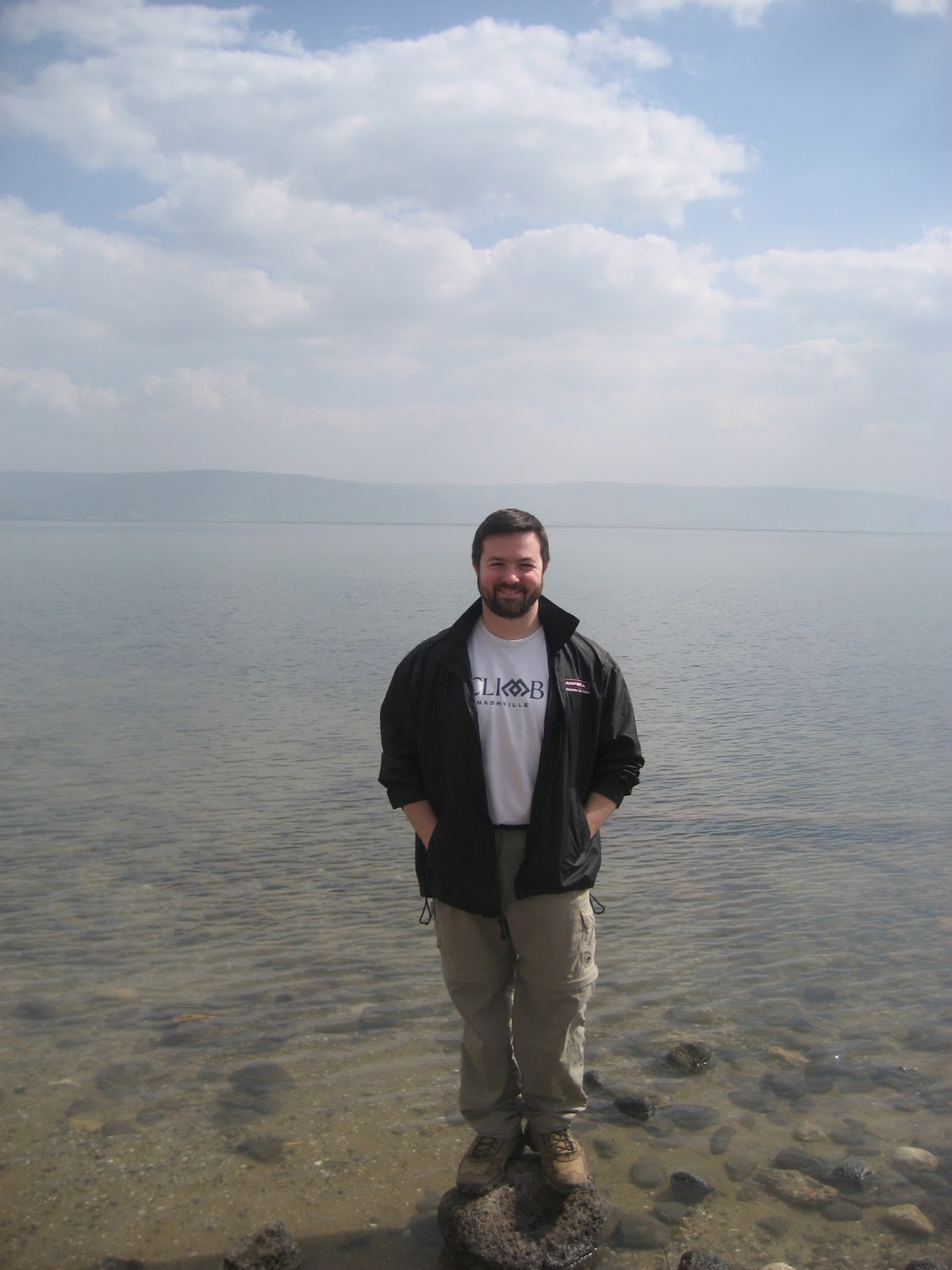
We spent the night in the town of Tiberius, so we woke up to this beautiful view of the Sea of Galilee (also known as Lake Tiberius) from our hotel room.
Our planned boat ride on the Sea of Galilee was pushed back a few hours, so we went to a place called the Wadi Hamman. "Wadi" is the Arabic word for "valley", and in this part of the world it refers specifically to a narrow, steep rift valley between two mountains. Wadi Hamman has long been the most accessible path between Nazareth and Galilee, with a flat, easy path and a stream. So we can be pretty sure that Jesus and the Disciples took this path back and forth many times!
We had planned to have our worship on the boat, but because of the delay we found a quiet spot in the Wadi by the stream. Most of my fellow travelers are clergy, so we all played different parts. I preached, and pastors representing three different traditions: Episcopal, United Church of Christ, and United Methodist, presided at the Communion Table, which was actually a boulder that we could imagine Jesus himself having rested on on his way between the towns. I'm rarely able to truly worship when I'm involved in leading the service, but this turned out to be one of the most meaningful worship experiences I've had in a very long time. Look for a post in the coming weeks on this, once I finish piecing my thoughts together.
We spent some time climbing the hillside and taking in the beauty of the place. All the churches and holy sites have been wonderful, but somehow God's presence has been most real to me on this trip in this quiet, serene place with no markers or shrines of any sort.
Afterward we went on a boat ride around the Sea of Galilee, and our captain gave us a demonstration of the way fishing worked back in the first century, casting a weighted net (although in the first century there wouldn't have been synthetic fibers!).
Next we took a walk in the hills of the Tabgha- a region on the North-West shore of the Sea of Galilee where there are several spots that claim to be the Mount of the Beatitudes- in other words, the place where Jesus preached the Sermon on the Mount. We stopped on the spot of the original Church of the Beatitudes (only foundation stones left) and passed around a Bible, reading the Sermon on the Mount (Matthew 5-7) aloud.
Quick aside- the Sermon on the Mount is probably not a historical event as such, but rather a collection of Jesus' ethical teachings complied into one discourse by the writer of Matthew, similar to Luke's Sermon on the Plain. Like most of the sites commemorating biblical events, it's impossible to know where they actually happened there. But these sites are important because they have been where these stories have come alive for people for centuries. Historicity isn't everything.
At the bottom of the hill we came to the Church of the Primacy of St. Peter, the spot where Jesus is said to have told Peter that he would be the "rock on which I (Jesus) will build my church" (Matthew 16:13-20). Our Roman Catholic friends consider this to be Jesus' endorsement of Peter's leadership, and that his successor, the Pope, is the chief pastor for all Christians. This church is on the shore of the Sea of Galilee, and several of my fellow travelers decided to bottle some of the water as a momento.
Finally, we were on to Capernaum, the town where Jesus may have had a home, or at the very least a home that he stayed in on a regular basis (it may have belong to Peter or his mother-in-law). There is a site that has been venerated as "Peter's House" since the mid-first century, and is encircled by several other ancient churches. There is a modern chapel built over it now, with glass in the middle of the floor looking down into "Peter's House". There is also a fourth century synagogue right across the street that is remarkably well preserved.
Then we cross the border into Jordan, which was quite easy, but I understand this will not be the case crossing back from Jordan into the West Bank. We're spending the next two nights in Amman and exploring the Christian origins in Jordan, as well as spending time with Jordanian Christians. Look for reports on this tomorrow.
Until then, enjoy the Oscars and be well!
Sunday, February 27, 2011
Saturday, February 26, 2011
Project Israel- Galilee
We left Bethlehem this morning (we'll return in a few days), heading north to see some really cool things.
Our first stop was Ceaserea Maratima- a spectacular city with a large artificial harbor built by Herod the Great, added on to by the Crusaders, and then the Muslims after running the Crusaders off.
Next we went to Tel-Megiddo, a place that has seen many cities over the past few thousand years and is still an active excavation site. The "Plain of Armageddon" (the Hebrew translation of Megiddo) is mentioned in Revelation 16:16 as a place where kings meet, and is interpreted to be the site of the great apocalyptic battle. This is strange, because it's such a peaceful place! The city also has an impressive tunnel to the nearby spring in the event of a siege, which turned out to be counter-productive, as a besieging army was able to sneak through it for a surprise attack.
Then we were of to a Kibbutz called Mishmar ha Emek, an Israeli commune (they're not Communists, however) were everyone shares their property in common and works in agriculture and light industry to support the Kibbutz. While the community is not religious at all, there are elements of their life together that resemble monastic communities. They are Zionists, but understand that in a very different way that what we usually think of when we hear that word. More on this later.
Finally we traveled to Nazareth. We visited the Convent of the Sisters of Nazareth, which sits over a number of Koch Tombs- graves hewn out of rock with stones rolled in front of them. These are very much like the tomb the gospels say Jesus was laid in. We also visited the Basilica of the Annunciation, which is built over an ancient well where tradition says Mary received a visit from the angel Gabriel, telling her she would be the mother of the Messiah.
(As you can probably tell by now, we're having some amazing encounters with people who live in the Holy Land, and I'm having to process what I'm learning about the current situation from these encounters. I probably won't be able to put them all together until I get back, so while I'm here these posts will just be short daily reports and photos, but look for more in depth analysis during the first few weeks of March.)
Tomorrow will include a boat ride and worship on the Sea of Galilee, Capernum, and the trip across the Jordanian border into Amman. Until then, be well!
Our first stop was Ceaserea Maratima- a spectacular city with a large artificial harbor built by Herod the Great, added on to by the Crusaders, and then the Muslims after running the Crusaders off.
Next we went to Tel-Megiddo, a place that has seen many cities over the past few thousand years and is still an active excavation site. The "Plain of Armageddon" (the Hebrew translation of Megiddo) is mentioned in Revelation 16:16 as a place where kings meet, and is interpreted to be the site of the great apocalyptic battle. This is strange, because it's such a peaceful place! The city also has an impressive tunnel to the nearby spring in the event of a siege, which turned out to be counter-productive, as a besieging army was able to sneak through it for a surprise attack.
Then we were of to a Kibbutz called Mishmar ha Emek, an Israeli commune (they're not Communists, however) were everyone shares their property in common and works in agriculture and light industry to support the Kibbutz. While the community is not religious at all, there are elements of their life together that resemble monastic communities. They are Zionists, but understand that in a very different way that what we usually think of when we hear that word. More on this later.
Finally we traveled to Nazareth. We visited the Convent of the Sisters of Nazareth, which sits over a number of Koch Tombs- graves hewn out of rock with stones rolled in front of them. These are very much like the tomb the gospels say Jesus was laid in. We also visited the Basilica of the Annunciation, which is built over an ancient well where tradition says Mary received a visit from the angel Gabriel, telling her she would be the mother of the Messiah.
(As you can probably tell by now, we're having some amazing encounters with people who live in the Holy Land, and I'm having to process what I'm learning about the current situation from these encounters. I probably won't be able to put them all together until I get back, so while I'm here these posts will just be short daily reports and photos, but look for more in depth analysis during the first few weeks of March.)
Tomorrow will include a boat ride and worship on the Sea of Galilee, Capernum, and the trip across the Jordanian border into Amman. Until then, be well!
Labels:
Annunciation,
Armageddon,
Ceasarea Maratima,
Kibbutz,
Megiddo,
Nazareth,
Project Israel
Friday, February 25, 2011
Project Israel- Bethlehem
After arriving in Tel Aviv on Thursday afternoon, we headed to our hotel in Bethlehem, but made a stop at the Shepherds' Fields first. There are actually three sites called "The Shepherds' Fields" in Bethlehem, each in the custody of a different group. The one we visited is in the custody of the Franciscans. No site claims to be the exact spot where the angels announced the birth of Jesus (Luke 2), since, as our guide said, events like this don't tend to leave archeological evidence.
The next day we started out at the Herodian- a gigantic hill top fortress Herod the Great built just outside of Bethlehem. He actually had the top of one hill removed to build up an adjacent hill so his palace could be seen from farther distances!
Next we visited the Church of the Nativity, which is the oldest Christian church in continuous use, for over 1700 years. Under the altar is the grotto where a star marks the place Jesus is said to have been born, and another grotto marks the spot where he is said to have been laid in the manger (again- events that don't tend to leave archeological evidence).
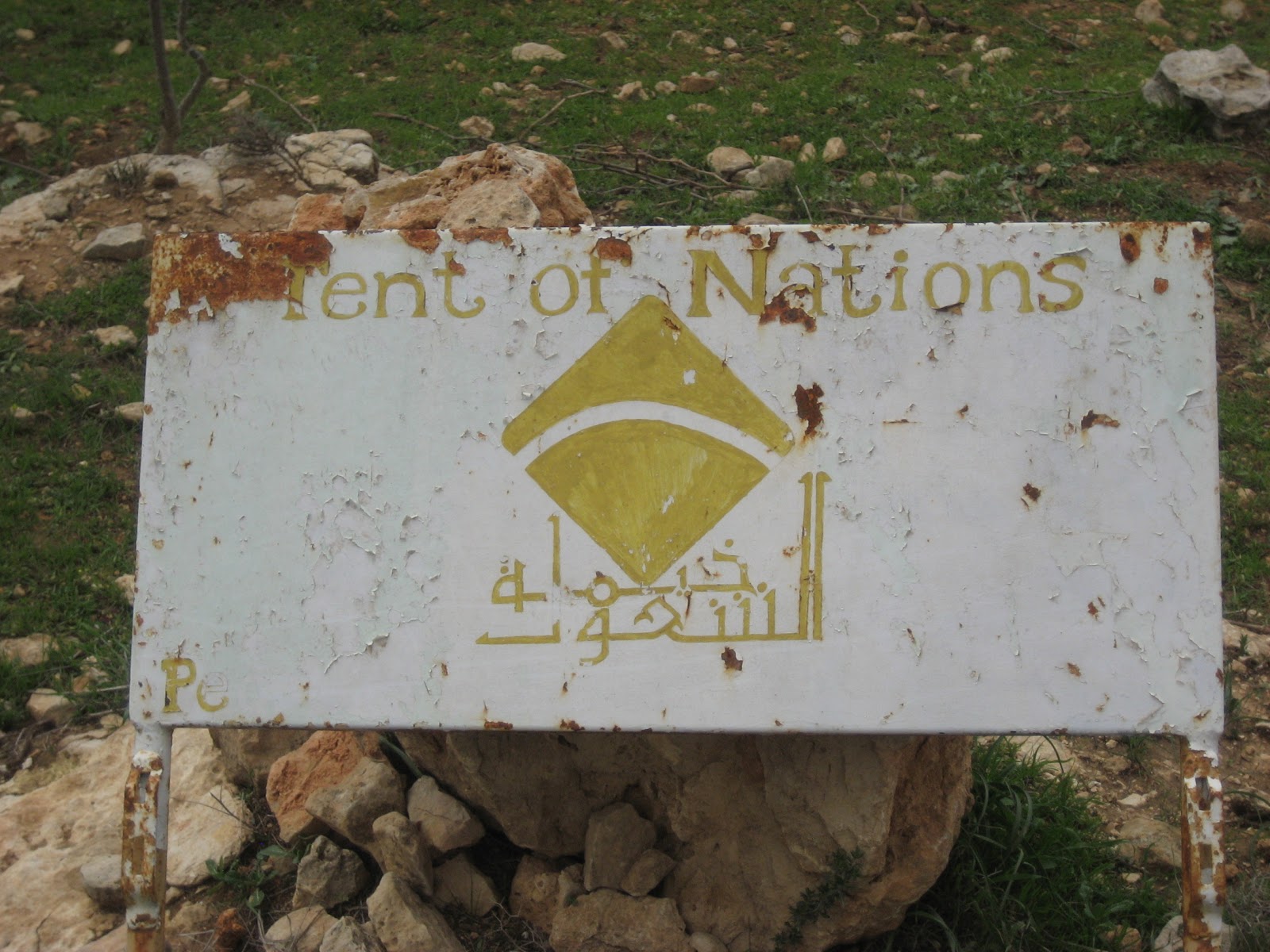
After those historical sites, we turned to more contemporary concerns. We visited the Tent of Nations- a farm on a hill that has belonged to a Palestinian Christian family for generations, who have stubbornly (dare I say faithfully?) held onto their land despite being surrounded by Israeli settlements that are in violation of the Camp David and Oslo accords, and despite repeated attempts by the Israeli government to declare it state land. It is still a working farm, as well as a place where programs are put on to promote peace between Israeli and Palestinian children.
Finally, we visited the al-Arob refugee camp on the outskirts of Bethlehem. The residents are descendants of the residents of a number of villages in southern Israel, who were "temporarily relocated" in 1948 so they could "avoid the war" with neighboring states. They were promised that they could return in two weeks, and though I want to believe that the brand new Israeli government legitimately meant two weeks, they are still there sixty-three years later.
I have quite a few thoughts bouncing around in my head about these two very different encounters with Palestinians today, but I think I need a couple days to process those thoughts into something coherent. So for now, I hope these brief reports and pictures will suffice.
Check in tomorrow for our experiences in Gaililee!
The next day we started out at the Herodian- a gigantic hill top fortress Herod the Great built just outside of Bethlehem. He actually had the top of one hill removed to build up an adjacent hill so his palace could be seen from farther distances!
Next we visited the Church of the Nativity, which is the oldest Christian church in continuous use, for over 1700 years. Under the altar is the grotto where a star marks the place Jesus is said to have been born, and another grotto marks the spot where he is said to have been laid in the manger (again- events that don't tend to leave archeological evidence).
After those historical sites, we turned to more contemporary concerns. We visited the Tent of Nations- a farm on a hill that has belonged to a Palestinian Christian family for generations, who have stubbornly (dare I say faithfully?) held onto their land despite being surrounded by Israeli settlements that are in violation of the Camp David and Oslo accords, and despite repeated attempts by the Israeli government to declare it state land. It is still a working farm, as well as a place where programs are put on to promote peace between Israeli and Palestinian children.
I have quite a few thoughts bouncing around in my head about these two very different encounters with Palestinians today, but I think I need a couple days to process those thoughts into something coherent. So for now, I hope these brief reports and pictures will suffice.
Check in tomorrow for our experiences in Gaililee!
Thursday, February 24, 2011
Project Israel- Getting There
Nashville, Cincinatti, New York, Istanbul, Tel Aviv, Bethlehem.
In the past 24 hours I've been in five cities, four airports, three countries and three time zones.
But we're here at our hotel in Bethlehem now. The network connection at our hotel is really slow, so I'll have to find an internet cafe today or tomorrow (it's 6:30 pm here, 10:30am at home) to post pictures and a longer recap.
Tomorrow we'll be seeing more of Bethlehem, which is inside the Palestinian Territory, seeing the Church of the Nativity, and visiting a refugee camp, among other things. Check back in soon!
In the past 24 hours I've been in five cities, four airports, three countries and three time zones.
But we're here at our hotel in Bethlehem now. The network connection at our hotel is really slow, so I'll have to find an internet cafe today or tomorrow (it's 6:30 pm here, 10:30am at home) to post pictures and a longer recap.
Tomorrow we'll be seeing more of Bethlehem, which is inside the Palestinian Territory, seeing the Church of the Nativity, and visiting a refugee camp, among other things. Check back in soon!
Tuesday, February 22, 2011
Project Israel- Books Read in Preparation
In preparation for the journey to the Holy Land (less than 24 hours to go!), I read/re-read a couple books to bone up on my knowledge of the land, the history, and the issues people are facing there right now.
The Word of God and the World of the Bible: An Introduction to the Cultural Backgrounds of the New Testament
This is a great book by Peter J. Miano, the Executive Director of the Society for Biblical Studies- the organization that put our trip together. The books stated purpose is to make insights from biblical scholarship accessible to people who are not scholars, and it largely accomplishes this. While some of the early chapters may be a tad remedial for someone who has been to seminary or even taken a Bible class or two in college, Miano makes complex concepts like the different forms of biblical criticism and cultural norms of the ancient Near East very accessible. I learned a lot from this book and would recommend it to anyone who wants to take the Bible seriously as a collection of ancient documents that has spoken to people across thousands of years all over the world.
We Can Have Peace in the Holy Land: A Plan That Will Work
This is Jimmy Carter's argument about how to solve the Israeli-Palestinian conflict as it existed in early 2009, and I do wonder how his opinion might have changed in light of recent events in the region. Like any book by a politician, particularly a former President, he spends a lot of time trying to shape people's perceptions of his place in history, but Carter does have a darn good legacy to promote on these issues. He is very gracious to his successors of both parties, praising their efforts on the peace process, and the appendices contain many of the important agreements and resolutions from the last half-century. He advocates a two-state solution with joint control of Jerusalem and significant involvement from the international community in economic and security issues. It seems to make sense on paper, but Carter does acknowledge that it's more complicated because of the recent history of violence between the groups. I'm looking forward to learning more about the personal feelings people bring to the table while I'm over there.
A History of Jerusalem: One City, Three Faiths
Karen Armstrong is really good at making detailed, nuanced historical study accessible to anyone, and much like Miano. It's not a quick read, but it helps the reader understand the long history of the city and how the different groups that have controlled it have shaped the geographical, political, social, and even spiritual landscape. Armstrong conveys the strong attachment many different groups have to this city and how complex the issues are surrounding its future.
Where God Was Born : A Journey by Land to the Roots of Religion
Bruce Feiler has written a number of really good books about popular religion, and his book about Abraham's place in the three major monotheistic religions is especially informative. The first section of this book mixes historical background with his accounts of travel in Israel, guided by men who fought in the modern state of Israel's earliest wars. His conversations with those warriors are very insightful and really give the reader a sense of how important the land is to those who live there. The last two sections tell similar tales about Iraq and Iran, and are also worth reading.
In retrospect, I wish I'd also read something that presents a Palestinian perspective on the events of the past century and their views on how to solve the current problems. I probably could have found one, but I stuck to books that were already on my shelf. I'm obviously out of time to do any more prep reading, but I'd love to hear from anyone who knows of any books that present Palestinian perspectives.
The Word of God and the World of the Bible: An Introduction to the Cultural Backgrounds of the New Testament
This is a great book by Peter J. Miano, the Executive Director of the Society for Biblical Studies- the organization that put our trip together. The books stated purpose is to make insights from biblical scholarship accessible to people who are not scholars, and it largely accomplishes this. While some of the early chapters may be a tad remedial for someone who has been to seminary or even taken a Bible class or two in college, Miano makes complex concepts like the different forms of biblical criticism and cultural norms of the ancient Near East very accessible. I learned a lot from this book and would recommend it to anyone who wants to take the Bible seriously as a collection of ancient documents that has spoken to people across thousands of years all over the world.
We Can Have Peace in the Holy Land: A Plan That Will Work
This is Jimmy Carter's argument about how to solve the Israeli-Palestinian conflict as it existed in early 2009, and I do wonder how his opinion might have changed in light of recent events in the region. Like any book by a politician, particularly a former President, he spends a lot of time trying to shape people's perceptions of his place in history, but Carter does have a darn good legacy to promote on these issues. He is very gracious to his successors of both parties, praising their efforts on the peace process, and the appendices contain many of the important agreements and resolutions from the last half-century. He advocates a two-state solution with joint control of Jerusalem and significant involvement from the international community in economic and security issues. It seems to make sense on paper, but Carter does acknowledge that it's more complicated because of the recent history of violence between the groups. I'm looking forward to learning more about the personal feelings people bring to the table while I'm over there.
A History of Jerusalem: One City, Three Faiths
Karen Armstrong is really good at making detailed, nuanced historical study accessible to anyone, and much like Miano. It's not a quick read, but it helps the reader understand the long history of the city and how the different groups that have controlled it have shaped the geographical, political, social, and even spiritual landscape. Armstrong conveys the strong attachment many different groups have to this city and how complex the issues are surrounding its future.
Where God Was Born : A Journey by Land to the Roots of Religion
Bruce Feiler has written a number of really good books about popular religion, and his book about Abraham's place in the three major monotheistic religions is especially informative. The first section of this book mixes historical background with his accounts of travel in Israel, guided by men who fought in the modern state of Israel's earliest wars. His conversations with those warriors are very insightful and really give the reader a sense of how important the land is to those who live there. The last two sections tell similar tales about Iraq and Iran, and are also worth reading.
In retrospect, I wish I'd also read something that presents a Palestinian perspective on the events of the past century and their views on how to solve the current problems. I probably could have found one, but I stuck to books that were already on my shelf. I'm obviously out of time to do any more prep reading, but I'd love to hear from anyone who knows of any books that present Palestinian perspectives.
Tuesday, February 15, 2011
Project Israel- Western Wall Prayers
One of the things I'm most excited about in the upcoming Holy Land trip is the opportunity to visit the Western Wall in Jerusalem, which is the only part of the Herod's Temple still left standing.
For centuries, people have visited the Western Wall, also known as the "Wailing Wall", to have a physical point of contact with the place where the Bible says God's Spirit dwelled, and was the focal point of worship in ancient Israel for centuries. People often write prayers on pieces of paper and leave them in the cracks of the wall.
On the first Sunday after our church building burned down, we made our own Wailing Wall out of bricks from one of the chimneys, writing prayers on paper and putting them in the cracks just like in Jerusalem.
I know that not many people get the chance to visit the Western Wall, so I want to share as much of the experience as I can. This Sunday, my congregation is going to write prayers on pieces of paper that I will then place in the Wailing Wall. I'd like to extend the same opportunity to the readers of this blog.
If you'd like me to place a prayer in the Western Wall for you, email it to me. I will immediately print it out and fold it up, doing my best not to look at any of the text so that it can be between you and God.
In the next few days I'll be sharing a few preliminary thoughts about the Israeli-Palestinian conflict and possible solutions, something I'll be asking people about when I'm over there. I'd love to hear your thoughts and questions, too. Feel free to share them below!
Saturday, February 05, 2011
Project Israel- Regional Unrest and the Stories We Tell
As I've said in earlier posts, I'm watching the political upheaval in Egypt and other countries in the region with more interest than I might otherwise, because I'll be traveling to the region in a few weeks. I spent most of my academic energy as a political science major in college studying the region, its history, and conflict, even before 9/11 made the average American realize that what happens overseas really does affect us.
Last night I got an interesting email from the Executive Director of the Society for Biblical Studies (the group that is guiding our trip), addressing the anxieties many people no doubt feel about traveling in the region.
One thing that he pointed out was that while the Western corporate media (an industry for whom he clearly has little regard) have reported that the King of Jordan recently dissolved his Parliament in the wake of anti-government demonstrations, they were only telling half the story. Jordan's government, while far from being free an democratic, is far more tolerant of dissent than is Egypt's, and such demonstrations are a regular occurrence. Furthermore, this is the third time in the last year that Jordan's King has dissolved Parliament. So while this particular news item was reporting the facts, it was only telling part of the story in an attempt to have it fit in with the main narrative of chaos and instability we've been seeing for the last two weeks.
This new information reminded me of how powerful the stories we tell about people, places, and groups really are. When we talk about a particular group or issue (or ourselves, as Donald Miller points out so well in A Million Miles in a Thousand Years: What I Learned While Editing My Life
), we don't say every single thing we know, because it would take too long. Instead, we craft a story to encapsulate what we believe.
One of the most common stories I hear about the Middle East from people I encounter on a daily basis goes something like this: "those people have been fighting each other over little pieces of land for thousands of years. I don't see why we (the United States) have to get involved when all they want to do is kill each other."
There are certain truths to that story. The Middle East has seen a lot of conflict throughout recorded human history, but it has a whole lot more to do with geography than some fundamental character flaw on the part of the people who live there. The Middle East, Israel in particular, has long been at the intersection of several crucial trade routes. Its coast offers easy access to Mediterranean Sea, and it lies on the land route between Europe, Asia, and Africa. So naturally it has been in the interest of many empires to control such trade routes, and different empires have fought each other for that control.
We also have to consider that under hundreds of years of rule by the Ottoman Empire, Jews, Muslims, and Christians lived together in relative peace. In 1919 the Ottomans found themselves on the losing end of World War I, and the whole Middle East region was carved up by diplomats in Versailles, and came under the rule of the British Empire. In the century since that time there has been lots of conflict, but it's clearly more complicated than just being an attribute of "those people".
I can't help but wonder if the "those people" story is one that is meant to keep a complex situation inside a box up on the shelf, so that we don't have to really engage with what our brothers and sisters experience on the other side of the world. Instead of the story inviting us into a deeper engagement, it keeps these others at arms length.
One of the most exciting things about the journey I will take later this month is that we will be spending time with locals, Israeli and Palestinian, learning from them what their day-to-day experience of this conflict is. Hopefully when I return I will be able to tell a better story about the Middle East than what I'm currently capable of doing.
Last night I got an interesting email from the Executive Director of the Society for Biblical Studies (the group that is guiding our trip), addressing the anxieties many people no doubt feel about traveling in the region.
One thing that he pointed out was that while the Western corporate media (an industry for whom he clearly has little regard) have reported that the King of Jordan recently dissolved his Parliament in the wake of anti-government demonstrations, they were only telling half the story. Jordan's government, while far from being free an democratic, is far more tolerant of dissent than is Egypt's, and such demonstrations are a regular occurrence. Furthermore, this is the third time in the last year that Jordan's King has dissolved Parliament. So while this particular news item was reporting the facts, it was only telling part of the story in an attempt to have it fit in with the main narrative of chaos and instability we've been seeing for the last two weeks.
This new information reminded me of how powerful the stories we tell about people, places, and groups really are. When we talk about a particular group or issue (or ourselves, as Donald Miller points out so well in A Million Miles in a Thousand Years: What I Learned While Editing My Life
One of the most common stories I hear about the Middle East from people I encounter on a daily basis goes something like this: "those people have been fighting each other over little pieces of land for thousands of years. I don't see why we (the United States) have to get involved when all they want to do is kill each other."
There are certain truths to that story. The Middle East has seen a lot of conflict throughout recorded human history, but it has a whole lot more to do with geography than some fundamental character flaw on the part of the people who live there. The Middle East, Israel in particular, has long been at the intersection of several crucial trade routes. Its coast offers easy access to Mediterranean Sea, and it lies on the land route between Europe, Asia, and Africa. So naturally it has been in the interest of many empires to control such trade routes, and different empires have fought each other for that control.
We also have to consider that under hundreds of years of rule by the Ottoman Empire, Jews, Muslims, and Christians lived together in relative peace. In 1919 the Ottomans found themselves on the losing end of World War I, and the whole Middle East region was carved up by diplomats in Versailles, and came under the rule of the British Empire. In the century since that time there has been lots of conflict, but it's clearly more complicated than just being an attribute of "those people".
I can't help but wonder if the "those people" story is one that is meant to keep a complex situation inside a box up on the shelf, so that we don't have to really engage with what our brothers and sisters experience on the other side of the world. Instead of the story inviting us into a deeper engagement, it keeps these others at arms length.
One of the most exciting things about the journey I will take later this month is that we will be spending time with locals, Israeli and Palestinian, learning from them what their day-to-day experience of this conflict is. Hopefully when I return I will be able to tell a better story about the Middle East than what I'm currently capable of doing.
Wednesday, February 02, 2011
Wedding Dress
I heard this song years ago, but in the last few days I've rediscovered it for some reason
"Wedding Dress" is off Derek Webb's 2003 album, She Must and Shall Go Free
(the whole disc is amazing, I highly recommend buying/downloading it)
I can't really explain why this song is speaking so profoundly to me right now. I just get the feeling that I got when I read Sarah Miles' first book, Take This Bread: A Radical Conversion
. It's like I saw what real Christianity is for the first time and I realize that what I've been fed (and subsequently fed to others) is severely lacking.
Maybe some of you can put it into words better than I can. What is it that makes this song so powerful?
"Wedding Dress" is off Derek Webb's 2003 album, She Must and Shall Go Free
I can't really explain why this song is speaking so profoundly to me right now. I just get the feeling that I got when I read Sarah Miles' first book, Take This Bread: A Radical Conversion
Maybe some of you can put it into words better than I can. What is it that makes this song so powerful?
Labels:
Christianity,
church,
Derek Webb,
song,
Wedding Dress
Subscribe to:
Posts (Atom)