Sunday, February 27, 2011

Project Israel- Galilee 2

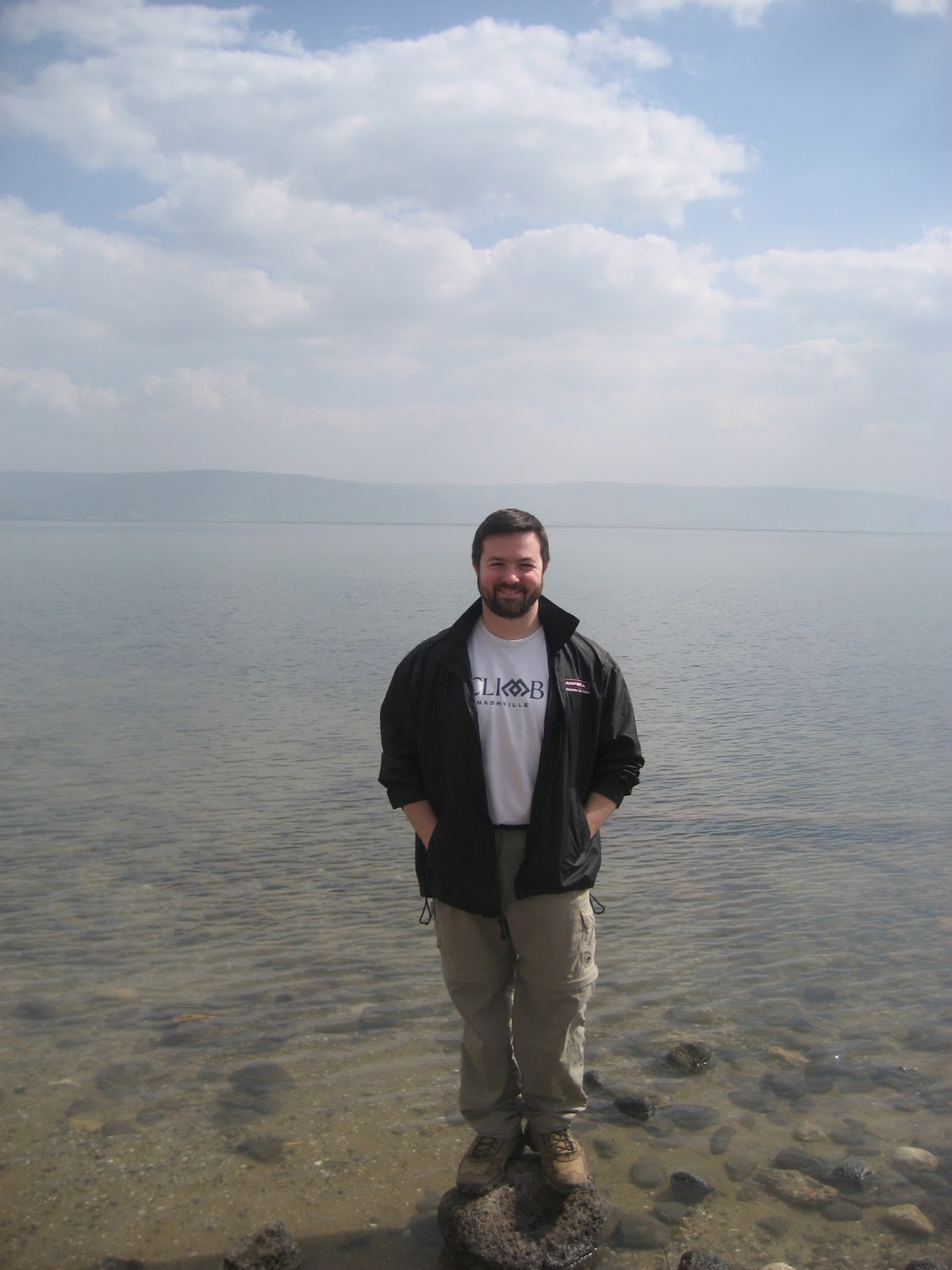
We spent the night in the town of Tiberius, so we woke up to this beautiful view of the Sea of Galilee (also known as Lake Tiberius) from our hotel room.


Our planned boat ride on the Sea of Galilee was pushed back a few hours, so we went to a place called the Wadi Hamman. "Wadi" is the Arabic word for "valley", and in this part of the world it refers specifically to a narrow, steep rift valley between two mountains. Wadi Hamman has long been the most accessible path between Nazareth and Galilee, with a flat, easy path and a stream. So we can be pretty sure that Jesus and the Disciples took this path back and forth many times!

We had planned to have our worship on the boat, but because of the delay we found a quiet spot in the Wadi by the stream. Most of my fellow travelers are clergy, so we all played different parts. I preached, and pastors representing three different traditions: Episcopal, United Church of Christ, and United Methodist, presided at the Communion Table, which was actually a boulder that we could imagine Jesus himself having rested on on his way between the towns. I'm rarely able to truly worship when I'm involved in leading the service, but this turned out to be one of the most meaningful worship experiences I've had in a very long time. Look for a post in the coming weeks on this, once I finish piecing my thoughts together.

We spent some time climbing the hillside and taking in the beauty of the place. All the churches and holy sites have been wonderful, but somehow God's presence has been most real to me on this trip in this quiet, serene place with no markers or shrines of any sort.


Afterward we went on a boat ride around the Sea of Galilee, and our captain gave us a demonstration of the way fishing worked back in the first century, casting a weighted net (although in the first century there wouldn't have been synthetic fibers!).


Next we took a walk in the hills of the Tabgha- a region on the North-West shore of the Sea of Galilee where there are several spots that claim to be the Mount of the Beatitudes- in other words, the place where Jesus preached the Sermon on the Mount. We stopped on the spot of the original Church of the Beatitudes (only foundation stones left) and passed around a Bible, reading the Sermon on the Mount (Matthew 5-7) aloud.
Quick aside- the Sermon on the Mount is probably not a historical event as such, but rather a collection of Jesus' ethical teachings complied into one discourse by the writer of Matthew, similar to Luke's Sermon on the Plain. Like most of the sites commemorating biblical events, it's impossible to know where they actually happened there. But these sites are important because they have been where these stories have come alive for people for centuries. Historicity isn't everything.


At the bottom of the hill we came to the Church of the Primacy of St. Peter, the spot where Jesus is said to have told Peter that he would be the "rock on which I (Jesus) will build my church" (Matthew 16:13-20). Our Roman Catholic friends consider this to be Jesus' endorsement of Peter's leadership, and that his successor, the Pope, is the chief pastor for all Christians. This church is on the shore of the Sea of Galilee, and several of my fellow travelers decided to bottle some of the water as a momento.


Finally, we were on to Capernaum, the town where Jesus may have had a home, or at the very least a home that he stayed in on a regular basis (it may have belong to Peter or his mother-in-law). There is a site that has been venerated as "Peter's House" since the mid-first century, and is encircled by several other ancient churches. There is a modern chapel built over it now, with glass in the middle of the floor looking down into "Peter's House". There is also a fourth century synagogue right across the street that is remarkably well preserved.


Then we cross the border into Jordan, which was quite easy, but I understand this will not be the case crossing back from Jordan into the West Bank. We're spending the next two nights in Amman and exploring the Christian origins in Jordan, as well as spending time with Jordanian Christians. Look for reports on this tomorrow.

Until then, enjoy the Oscars and be well!

Saturday, February 26, 2011

Project Israel- Galilee

We left Bethlehem this morning (we'll return in a few days), heading north to see some really cool things.

Our first stop was Ceaserea Maratima- a spectacular city with a large artificial harbor built by Herod the Great, added on to by the Crusaders, and then the Muslims after running the Crusaders off.


Next we went to Tel-Megiddo, a place that has seen many cities over the past few thousand years and is still an active excavation site. The "Plain of Armageddon" (the Hebrew translation of Megiddo) is mentioned in Revelation 16:16 as a place where kings meet, and is interpreted to be the site of the great apocalyptic battle. This is strange, because it's such a peaceful place! The city also has an impressive tunnel to the nearby spring in the event of a siege, which turned out to be counter-productive, as a besieging army was able to sneak through it for a surprise attack.


Then we were of to a Kibbutz called Mishmar ha Emek, an Israeli commune (they're not Communists, however) were everyone shares their property in common and works in agriculture and light industry to support the Kibbutz. While the community is not religious at all, there are elements of their life together that resemble monastic communities. They are Zionists, but understand that in a very different way that what we usually think of when we hear that word. More on this later.


Finally we traveled to Nazareth. We visited the Convent of the Sisters of Nazareth, which sits over a number of Koch Tombs- graves hewn out of rock with stones rolled in front of them. These are very much like the tomb the gospels say Jesus was laid in. We also visited the Basilica of the Annunciation, which is built over an ancient well where tradition says Mary received a visit from the angel Gabriel, telling her she would be the mother of the Messiah.


(As you can probably tell by now, we're having some amazing encounters with people who live in the Holy Land, and I'm having to process what I'm learning about the current situation from these encounters. I probably won't be able to put them all together until I get back, so while I'm here these posts will just be short daily reports and photos, but look for more in depth analysis during the first few weeks of March.)

Tomorrow will include a boat ride and worship on the Sea of Galilee, Capernum, and the trip across the Jordanian border into Amman. Until then, be well!

Friday, February 25, 2011

Project Israel- Bethlehem

After arriving in Tel Aviv on Thursday afternoon, we headed to our hotel in Bethlehem, but made a stop at the Shepherds' Fields first. There are actually three sites called "The Shepherds' Fields" in Bethlehem, each in the custody of a different group. The one we visited is in the custody of the Franciscans. No site claims to be the exact spot where the angels announced the birth of Jesus (Luke 2), since, as our guide said, events like this don't tend to leave archeological evidence.


The next day we started out at the Herodian- a gigantic hill top fortress Herod the Great built just outside of Bethlehem. He actually had the top of one hill removed to build up an adjacent hill so his palace could be seen from farther distances!


Next we visited the Church of the Nativity, which is the oldest Christian church in continuous use, for over 1700 years. Under the altar is the grotto where a star marks the place Jesus is said to have been born, and another grotto marks the spot where he is said to have been laid in the manger (again- events that don't tend to leave archeological evidence).


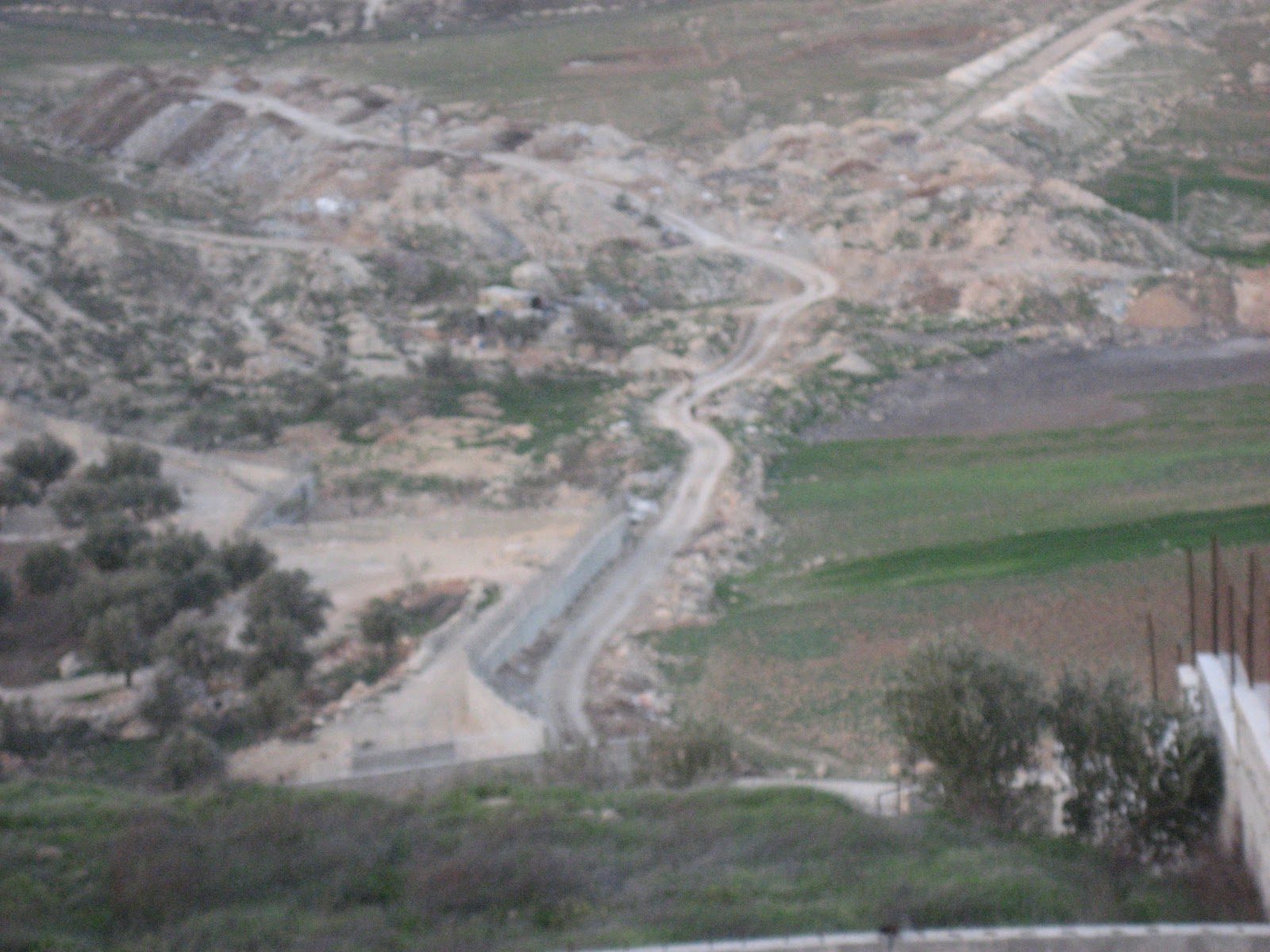
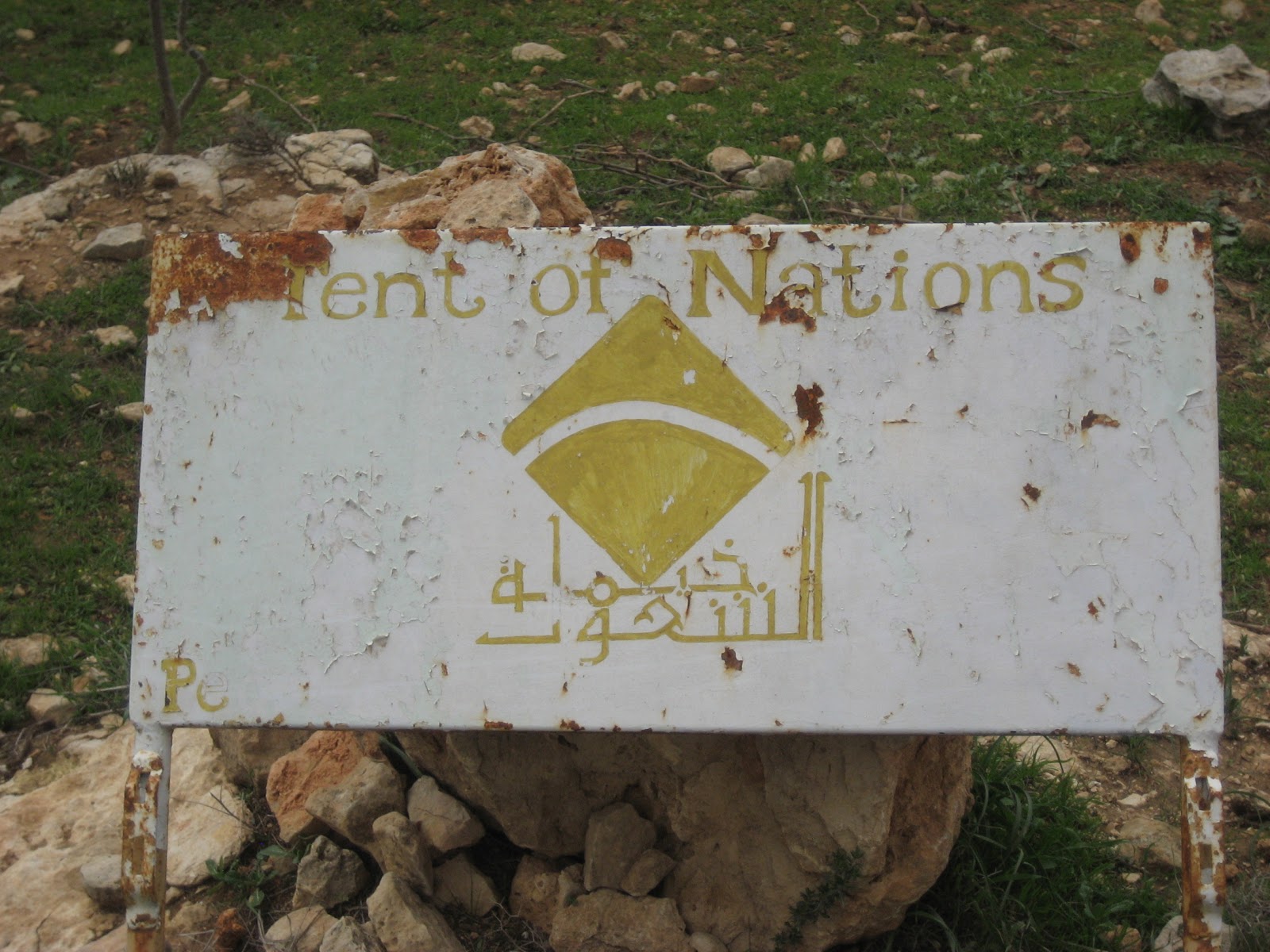
After those historical sites, we turned to more contemporary concerns. We visited the Tent of Nations- a farm on a hill that has belonged to a Palestinian Christian family for generations, who have stubbornly (dare I say faithfully?) held onto their land despite being surrounded by Israeli settlements  that are in violation of the Camp David and Oslo accords, and despite repeated attempts by the Israeli government to declare it state land. It is still a working farm, as well as a place where programs are put on to promote peace between Israeli and Palestinian children.


Finally, we visited the al-Arob refugee camp on the outskirts of Bethlehem. The residents are descendants of the residents of a number of villages in southern Israel, who were "temporarily relocated" in 1948 so they could "avoid the war" with neighboring states. They were promised that they could return in two weeks, and though I want to believe that the brand new Israeli government legitimately meant two weeks, they are still there sixty-three years later.


I have quite a few thoughts bouncing around in my head about these two very different encounters with Palestinians today, but I think I need a couple days to process those thoughts into something coherent. So for now, I hope these brief reports and pictures will suffice.

Check in tomorrow for our experiences in Gaililee!

Thursday, February 24, 2011

Project Israel- Getting There

Nashville, Cincinatti, New York, Istanbul, Tel Aviv, Bethlehem.

In the past 24 hours I've been in five cities, four airports, three countries and three time zones.

But we're here at our hotel in Bethlehem now. The network connection at our hotel is really slow, so I'll have to find an internet cafe today or tomorrow (it's 6:30 pm here, 10:30am at home) to post pictures and a longer recap.

Tomorrow we'll be seeing more of Bethlehem, which is inside the Palestinian Territory, seeing the Church of the Nativity, and visiting a refugee camp, among other things. Check back in soon!

Tuesday, February 22, 2011

Project Israel- Books Read in Preparation

In preparation for the journey to the Holy Land (less than 24 hours to go!), I read/re-read a couple books to bone up on my knowledge of the land, the history, and the issues people are facing there right now.

The Word of God and the World of the Bible: An Introduction to the Cultural Backgrounds of the New Testament
This is a great book by Peter J. Miano, the Executive Director of the Society for Biblical Studies- the organization that put our trip together. The books stated purpose is to make insights from biblical scholarship accessible to people who are not scholars, and it largely accomplishes this. While some of the early chapters may be a tad remedial for someone who has been to seminary or even taken a Bible class or two in college, Miano makes complex concepts like the different forms of biblical criticism and cultural norms of the ancient Near East very accessible. I learned a lot from this book and would recommend it to anyone who wants to take the Bible seriously as a collection of ancient documents that has spoken to people across thousands of years all over the world.

We Can Have Peace in the Holy Land: A Plan That Will Work
This is Jimmy Carter's argument about how to solve the Israeli-Palestinian conflict as it existed in early 2009, and I do wonder how his opinion might have changed in light of recent events in the region. Like any book by a politician, particularly a former President, he spends a lot of time trying to shape people's perceptions of his place in history, but Carter does have a darn good legacy to promote on these issues. He is very gracious to his successors of both parties, praising their efforts on the peace process, and the appendices contain many of the important agreements and resolutions from the last half-century. He advocates a two-state solution with joint control of Jerusalem and significant involvement from the international community in economic and security issues. It seems to make sense on paper, but Carter does acknowledge that it's more complicated because of the recent history of violence between the groups. I'm looking forward to learning more about the personal feelings people bring to the table while I'm over there.

A History of Jerusalem: One City, Three Faiths
Karen Armstrong is really good at making detailed, nuanced historical study accessible to anyone, and much like Miano. It's not a quick read, but it helps the reader understand the long history of the city and how the different groups that have controlled it have shaped the geographical, political, social, and even spiritual landscape. Armstrong conveys the strong attachment many different groups have to this city and how complex the issues are surrounding its future.

Where God Was Born : A Journey by Land to the Roots of Religion
Bruce Feiler has written a number of really good books about popular religion, and his book about Abraham's place in the three major monotheistic religions is especially informative. The first section of this book mixes historical background with his accounts of travel in Israel, guided by men who fought in the modern state of Israel's earliest wars. His conversations with those warriors are very insightful and really give the reader a sense of how important the land is to those who live there. The last two sections tell similar tales about Iraq and Iran, and are also worth reading.

In retrospect, I wish I'd also read something that presents a Palestinian perspective on the events of the past century and their views on how to solve the current problems. I probably could have found one, but I stuck to books that were already on my shelf. I'm obviously out of time to do any more prep reading, but I'd love to hear from anyone who knows of any books that present Palestinian perspectives.

Tuesday, February 15, 2011

Project Israel- Western Wall Prayers


One of the things I'm most excited about in the upcoming Holy Land trip is the opportunity to visit the Western Wall in Jerusalem, which is the only part of the Herod's Temple still left standing.


For centuries, people have visited the Western Wall, also known as the "Wailing Wall", to have a physical point of contact with the place where the Bible says God's Spirit dwelled, and was the focal point of worship in ancient Israel for centuries. People often write prayers on pieces of paper and leave them in the cracks of the wall. 

On the first Sunday after our church building burned down, we made our own Wailing Wall out of bricks from one of the chimneys, writing prayers on paper and putting them in the cracks just like in Jerusalem.

I know that not many people get the chance to visit the Western Wall, so I want to share as much of the experience as I can. This Sunday, my congregation is going to write prayers on pieces of paper that I will then place in the Wailing Wall. I'd like to extend the same opportunity to the readers of this blog.

If you'd like me to place a prayer in the Western Wall for you, email it to me. I will immediately print it out and fold it up, doing my best not to look at any of the text so that it can be between you and God.

In the next few days I'll be sharing a few preliminary thoughts about the Israeli-Palestinian conflict and possible solutions, something I'll be asking people about when I'm over there. I'd love to hear your thoughts and questions, too. Feel free to share them below!

Saturday, February 05, 2011

Project Israel- Regional Unrest and the Stories We Tell

As I've said in earlier posts, I'm watching the political upheaval in Egypt and other countries in the region with more interest than I might otherwise, because I'll be traveling to the region in a few weeks. I spent most of my academic energy as a political science major in college studying the region, its history, and conflict, even before 9/11 made the average American realize that what happens overseas really does affect us.

Last night I got an interesting email from the Executive Director of the Society for Biblical Studies (the group that is guiding our trip), addressing the anxieties many people no doubt feel about traveling in the region.

One thing that he pointed out was that while the Western corporate media (an industry for whom he clearly has little regard) have reported that the King of Jordan recently dissolved his Parliament in the wake of anti-government demonstrations, they were only telling half the story. Jordan's government, while far from being free an democratic, is far more tolerant of dissent than is Egypt's, and such demonstrations are a regular occurrence. Furthermore, this is the third time in the last year that Jordan's King has dissolved Parliament. So while this particular news item was reporting the facts, it was only telling part of the story in an attempt to have it fit in with the main narrative of chaos and instability we've been seeing for the last two weeks.

This new information reminded me of how powerful the stories we tell about people, places, and groups really are. When we talk about a particular group or issue (or ourselves, as Donald Miller points out so well in A Million Miles in a Thousand Years: What I Learned While Editing My Life), we don't say every single thing we know, because it would take too long. Instead, we craft a story to encapsulate what we believe.

One of the most common stories I hear about the Middle East from people I encounter on a daily basis goes something like this: "those people have been fighting each other over little pieces of land for thousands of years. I don't see why we (the United States) have to get involved when all they want to do is kill each other."

There are certain truths to that story. The Middle East has seen a lot of conflict throughout recorded human history, but it has a whole lot more to do with geography than some fundamental character flaw on the part of the people who live there. The Middle East, Israel in particular, has long been at the intersection of several crucial trade routes. Its coast offers easy access to Mediterranean Sea, and it lies on the land route between Europe, Asia, and Africa. So naturally it has been in the interest of many empires to control such trade routes, and different empires have fought each other for that control.

We also have to consider that under hundreds of years of rule by the Ottoman Empire, Jews, Muslims, and Christians lived together in relative peace. In 1919 the Ottomans found themselves on the losing end of World War I, and the whole Middle East region was carved up by diplomats in Versailles, and came under the rule of the British Empire. In the century since that time there has been lots of conflict, but it's clearly more complicated than just being an attribute of "those people".

I can't help but wonder if the "those people" story is one that is meant to keep a complex situation inside a box up on the shelf, so that we don't have to really engage with what our brothers and sisters experience on the other side of the world. Instead of the story inviting us into a deeper engagement, it keeps these others at arms length.

One of the most exciting things about the journey I will take later this month is that we will be spending time with locals, Israeli and Palestinian, learning from them what their day-to-day experience of this conflict is. Hopefully when I return I will be able to tell a better story about the Middle East than what I'm currently capable of doing.

Wednesday, February 02, 2011

Wedding Dress

I heard this song years ago, but in the last few days I've rediscovered it for some reason


"Wedding Dress" is off Derek Webb's 2003 album, She Must and Shall Go Free (the whole disc is amazing, I highly recommend buying/downloading it)

I can't really explain why this song is speaking so profoundly to me right now. I just get the feeling that I got when I read Sarah Miles' first book, Take This Bread: A Radical Conversion. It's like I saw what real Christianity is for the first time and I realize that what I've been fed (and subsequently fed to others) is severely lacking.

Maybe some of you can put it into words better than I can. What is it that makes this song so powerful?

Saturday, January 29, 2011

Project Israel- Egyptian Unrest


Unless you've been living under a rock for the past few days (or if your internet has been cut off, but if that's the case, then you're probably there!), you've seen the growing anti-government protests that started in Tunisia and spread to Egypt. As of Saturday morning, dozens are dead, hundreds injured, and the estimated damage to property is already getting into the billions. There are even reports that some priceless artifacts in the Egyptian Museum may have been damaged by rioters. Maybe the British were right to take all that stuff to London!

Our group is scheduled to travel to that region in only a few weeks, so needless to say, I've been watching the news carefully. We won't be crossing the Egyptian border, the group we're traveling with is constantly monitoring safety issues, and Israel's security infrastructure is likely the strongest in the world (thanks mostly to lots of US Foreign Aid dollars), so I'm not afraid for my safety.

That being said, it's only 264 miles from Cairo, where the worst of the rioting is happening, and Jerusalem. For some perspective, that's less than the distance between Nashville, TN and Indianapolis, IN- a journey I made frequently in college; and just a bit farther than the distance between my hometown of Nashville and Jessica's hometown of Louisville, KY.

I'm not really drawing any big conclusions here, it's just something interesting to ponder. Regardless of my travel plans, I'm praying for all those affected by the violence over there, and I hope you will, too.

Sunday, January 23, 2011

Project Israel


One month from today I'll be leaving for a ten day trip to the Holy Land with a group of young United Methodist clergy and several members of the UMC's General Board of Church and Society. And guess what? You're invited!

I'm going to be documenting our experience through this blog, photos, and video, and I'll be posting here as frequently as I can while I'm over there, depending on availability of internet service. I want you all to be part of the experience.

We'll be doing many of the traditional pilgrimage activities, of course, but we're also going to be spending time with Israelis and Palestinians to learn about their everyday experiences and explore the ongoing conflict there from the ground level.

So my question to you readers is, what do you want to find out about? What questions would you like me to ask people when I'm over there? What issues would you like for us to explore in the next month before we leave?

I'm really excited about this opportunity, and I hope you will join me in making this a unique interactive experience.

Monday, January 17, 2011

Remembering the Unsafe Dr. King

Today is Martin Luther King, Jr. day here in the States, and there are not shortage of good articles and blog posts reflecting on his legacy out there. Tony Jones directed me to an excellent post by Postmodern Negro where he has a conversation with the spirit of St. Martin in prayer.

I've used this holiday in the past few years to remind my readers that while Martin Luther King is rightly celebrated, he is also sanitized by our culture and used as a way to imply that race is no longer an issue in our society. We also largely ignore the broader justice issues that he stood for, racial equality being one of them.

As a way to remember the Dr. King who is still unsafe an uncomfortably challenging to our culture, take a few minutes and listen to a speech he gave at Riverside Church in New York City, stating his opposition to the Vietnam War and make a whole lot of people angry, including many friends and allies.

Wednesday, January 12, 2011

Haiti, One Year Later

On the anniversary of Haiti's terrible earthquake, I'm praying for those that are still suffering, and giving thanks for all those who participated in the relief effort, incomplete though it is.

Here is the sermon I preached a few days after the earthquake.

On November 1, 1755, at about 10:30 in the morning, a magnitude 9 earthquake hit off the coast of Portugal. The quake, and the resulting tsunami and fires, totally destroyed the city of Lisbon and killed nearly 100,000 people, and the chaos nearly destroyed the Kingdom of Portugal. Because this earthquake happened during the daytime, and because it was on November 1, All Saints’ Day, many of the victims in this devoutly Catholic kingdom were killed as they were sitting in church, praying for the souls of departed friends and loved ones! Although the question of God’s goodness and mercy in light of human suffering has been around as long as human beings have been able to to conceive of a higher power, the Lisbon earthquake did more to put this question to the forefront of people’s minds than any single event would, probably until the Holocaust.

Thinkers of an emerging movement called “modernism” like Kant, Voltaire, and Rousseau all began to ask very deep questions about what they had always been taught about the nature of God. How, on a day of holy obligation, when so many people were doing exactly what they thought God wanted them to do, would God send such a devastating earthquake, something which, at the time was universally believed to be a sign of God’s wrath? Why would a good and loving God do such an awful thing?
Of course, in the centuries since the Lisbon quake we have learned more about the natural world, how earthquakes and volcanoes are the growing pains of a living planet that is continually replenishing itself. This knowledge has made the question of God’s role in human suffering a little easier to live with, but only slightly so. This increased knowledge of the natural world has led some people, most notably Thomas Jefferson, to embrace an idea called “deism”, where God is viewed like a clock-maker, having put the pieces together and set them in motion, but not intervening after that. Most Christians, however, haven’t given up completely on the idea of God playing a role in our world, but no one really agrees on just how that works. We certainly saw that this week when Pat Robertson decided to blame the victims in Haiti for their suffering. By the way, I hope you all were as saddened by his comments as I was.

But the truth is we don’t really know. We don’t really know how to even begin to discern what God’s role in tragedies like these are. And when we don’t know what to do or think, it’s always a good idea to turn to the Bible, to search the witness of those who have come before us and wrestled with these same questions for some guidance. I’d like to read a passage from the prophet Ezekiel (18:25-32).

Yet you say, 'The way of the Lord is not just.' Hear, O house of Israel: Is my way unjust? Is it not your ways that are unjust? If a righteous man turns from his righteousness and commits sin, he will die for it; because of the sin he has committed he will die. But if a wicked man turns away from the wickedness he has committed and does what is just and right, he will save his life. Because he considers all the offenses he has committed and turns away from them, he will surely live; he will not die. Yet the house of Israel says, 'The way of the Lord is not just.' Are my ways unjust, O house of Israel? Is it not your ways that are unjust? Therefore, O house of Israel, I will judge you, each one according to his ways, declares the Sovereign LORD. Repent! Turn away from all your offenses; then sin will not be your downfall. Rid yourselves of all the offenses you have committed, and get a new heart and a new spirit. Why will you die, O house of Israel? For I take no pleasure in the death of anyone, declares the Sovereign LORD. Repent and live!

Ezekiel is speaking to a people who are asking the same kinds of questions we are right now. The people of Israel are in exile, no longer in the land that they thought God had promised would always be theirs, now living under the thumb of a foreign empire. They are looking at this horrible tragedy that has befallen them and asking how to mesh their understanding of God’s goodness and mercy with their present circumstances. In addressing these questions, the prophet Ezekiel, speaking on behalf of God, does something interesting: he reframes the question. “Why do you say the ways of the Lord are unfair? Is it not your ways that are unfair, O Israel?” Ezekiel suggests that in addition to asking about God’s role in a tragedy, we should also ask what role we have to play in it. In fact, taking a long, hard look at ourselves might be a more productive route because it’s easier to evaluate ourselves than to guess at the mind of God.

The way that Ezekiel reframes the center of the question from God to us might just be the way to go. Consider this: fifteen years ago a magnitude 7 earthquake hit the San Francisco Bay area, and sixty-three people were killed. On Tuesday a magnitude 7 earthquake hit off the coast of Haiti, and the earliest estimates are that at least fifty thousand people died. Same intensity, astronomically higher body count. The difference in the tragedy has nothing to do with God loving one group more than another. The difference is that as one of the wealthiest urban areas in the wealthiest nation on earth, the people of San Francisco can build structures that can withstand the shock of an earthquake. As one of the poorest nations on earth, the people of Haiti have to build their homes, schools, and churches out of whatever they can find: most often pieces of corrugated tin and concrete blocks. The real tragedy of Haiti is not the earthquake. The real tragedy is that our brothers and sisters living in poverty are the most vulnerable and always suffer the most when nature turns ugly. “Why do you say the ways of the Lord are unfair? Is it not our ways that are unfair?”

If we ask that question of ourselves, if we consider that there might be something lacking in the way that we behave as global citizens, we are, of course, led to ask just what it is that we have done. What did we do wrong? After all, none of us here today are particularly wealthy, and as individuals we have very little influence over any kinds of economic or foreign policies. What’s more, many people here today, as members of the US military, have actively participated in humanitarian efforts in other nations. So we rightly ask just what it is about our ways that are unfair.

Perhaps our guilt in humanitarian disasters like the one on our TV screens this week lies not so much in sins of commission, but in sins of omission. In the confession in our liturgy of Holy Communion we ask God’s forgiveness for the things we have done, and the things we have left undone. Perhaps we are guilty of sins of omission.

Sins of omission, after all, are very understandable. When we look at the many varied and complex problems of our world, we quickly become overwhelmed. After all, many of us have to struggle and sacrifice to make ends meet each month, so anything we could do would be just a drop in the bucket. It’s overwhelming, so we change the channel, if you will. We look the other way because we feel helpless, and it’s just too painful. And after a while looking the other way gets easier and easier, until we can’t even see our brothers and sisters suffering right before our eyes. Perhaps our fault lies in a sin of omission.

After September 11, 2001, one of the slogans we often heard was “never forget”. Never forget those who lost their lives, never forget those who labor to keep us safe. Never forget. May I suggest that the way for us to repent of our sins of omission is to revive that slogan for our day. Let us never forget that three billion people on this planet live on less than two dollars a day. Never forget the thirty thousand children that die each day from lack of adequate nutrition and clean drinking water. Never forget that we are commanded to treat all who are hungry, thirsty, sick, lonely, and hopeless just as we would treat Jesus Christ himself.

When the news cameras are turned off and the biggest headline is about the latest person to get booted off of “American Idol”, let us never forget that our mission is not complete until each and every one of God’s six billion children has the means to survive the day. May we never forget, may we repent of our sins of omission, may we turn towards those who are suffering. For then we will all truly live.
Saturday, January 01, 2011

The Holy Machine

Happy New Year? Ready for some deep thoughts to start off 2011?

Today I came across a really interesting passage in The Other Side of the Mountain: The End of the Journey (Journal of Thomas Merton), which is the last volume in his journals before his untimely death in December of 1968.

On Christmas Eve of 1967, Merton was experiencing a lot of tension in the monastery and in his own life. He was questioning his calling in a very deep way, and it didn't help that Gethsemane was experiencing a divisive election of a new abbot. Merton was floated as a candidate for the position, but did not want it and made that quite clear to everyone.

He expressed his frustration in these words:

The Church is a great treadmill, and when you turn it, it churns out and ineffable substance called grace, and he who gets his pail full is thereafter untouchable, impervious to everything, neither man nor God can tell him anything. He is justified. He is right. He has a right to bash your head in if you even think of questioning it.


I can identify with Father Thomas' feelings. He is chest deep in "church politics", when people let the lesser sides of their humanness run the day and make others cynical about the real value of the church. Vietnam and contentious debates about "Just War" are also very much on his mind. Merton is talking specifically about the Roman Catholic Church, being part of a strict monastic order, but you could easily apply his comments to any organized religious group.

Anyone who spends much time deeply engaged in any type of faith community experiences this kind of disillusionment, and it can be a regular occurrence if you are a clergy-person. 2010 was a year full of these kind of low moments for me on a number of levels, and right now I'm finding myself in a place where I'm still climbing out of a deep funk.

The good news, though, is that God is with us in these low places as much as anywhere else, and it is in these low places that we experience God's grace more powerfully because we are much more aware of our need for it.

As stuck as I can feel sometimes, I know that God is leading me through these dark places into a better future where I will be stronger for having gone through it. And God will continue to use the Holy Machine of the Church, in spite of and even through its many flaws. In 2011, I'm going to try very hard to choose to not give up on the Church Universal, even in moments of frustration and anxiety. God hasn't given up on us, so why should we?

Wednesday, December 29, 2010

Sports Moment of the Year

Bob Ryan is one of the better sports talking-heads out there. "Around the Horn" is always better when he's on the panel (incidentally, the show is so much better since they gave Jay Mariotti the boot). For further proof that the guy knows what he's talking about, here's his "Moment of the Year" in sports:


While his description causes all Butler fans to relive the pain of Gordon Hayward's almost-there buzzer beater, he's right in saying that Butler's tournament run proves that anything really is possible.

Tuesday, December 28, 2010

The Holy Innocents

Today our Roman Catholic brethren are observing the Feast of the Holy Innocents, where they recall the story from Matthew's gospel where Herod orders the massacre of male infants in an attempt to wipe out anyone who would usurp his throne.

While this historicity of this story is pretty doubtful (Matthew includes it to strengthen the theme of Jesus as the new Moses), it does remind us that throughout human history, even at this very moment, there are untold numbers of holy innocent children that suffer and die needlessly.

It's estimated that as many as 30,000 children die every single day all over the world from malnutrition and other hunger related conditions. As an American who consumes far more than my fair share of the world's resources, I'm led to conclude that in many ways, I stand in the shoes of Herod on this Feast of the Holy Innocents.

So today I'm making a small gesture to help those holy innocents, most of whom will not be remembered by the world. I'm making a donation to Bread for the World, which is a great organization helping to fight hunger all over the world.

If you could find a way today to make a gift to them or any other charity you deem worthy, those holy innocents who are forgotten by the world, but are precious in God's sight, will be very grateful.

Saturday, December 25, 2010

Archbishop Williams' Christmas Message

This morning (after presents, stockings, breakfasts, etc.), I was perusing the Christmas messages of prominent religious figures, and I found Dr. Rowan Williams, Archbishop of Canterbury's Christmas Eve sermon particularly moving. The challenge he issues is aimed primarily at Britons, but it's quite applicable to us here in the states.

Canterbury's website has the text, and ITN has a small portion of the video:


(someone please let me know if you find the full video).

May you all have a blessed and peaceful Christmas.

Saturday, December 18, 2010

12 Days of Christmas

I haven't been blogging much lately, not because I don't have thoughts that I want to share, I'm just not able to put them together in any coherent fashion. Once I've had some space to reflect on what I've been experiencing lately, I'll share more.

That said, in the spirit of the season, here's something that brings a smile to my face. I hope it does yours, too.

Tuesday, December 07, 2010

1 Corinthians- Christmas Version

A colleague forwarded this to me today, and it really spoke to where I'm at right now. I'm having trouble experiencing any sort of peace or joy this Advent, and Paul's word interpreted to the season helped remind me of what is really important. May it be a blessing to you, as well.

1 Corinthians 13 (Christmas Version) –Author unknown

If I decorate my house perfectly with plaid bows, strands of twinkling lights and shiny balls, but do not show love to my family, I’m just another decorator.

If I slave away in the kitchen, baking dozens of Christmas cookies, preparing gourmet meals and arranging a beautifully adorned table at mealtime, but do not show love to my family, I’m just another cook.

If I work at the soup kitchen, carol in the nursing home and give all that I have to charity, but do not show love to my family, it profits me nothing.

If I trim the spruce with shimmering angels and crocheted snowflakes, attend a myriad of holiday parties and sing in the choir’s cantata but do not focus on Christ, I have missed the point.

Love stops the cooking to hug the child. Love sets aside the decorating to kiss the husband. Love is kind, though harried and tired. Love doesn’t envy another’s home that has coordinated Christmas china and table linens.

Love doesn’t yell at the kids to get out of the way, but is thankful they are there to be in the way. Love doesn’t give only to those who are able to give in return but rejoices in giving to those who can’t.

Love bears all things, believes all things, hopes all things, endures all things. Love never fails. Video games will break, pearl necklaces will be lost, golf clubs will rust, but giving the gift of love will endure.